Paper Discussion: Governance Failure Caused by the Bullwhip Effect
(This article mainly discusses the governance failure in manufacturing supply chains caused by the bullwhip effect, as explored in The Bullwhip Effect in SC by Hau L. Lee, V. Padmanabhan, and Seungjin Whang.)
When Supply Chain Issues Are No Longer Just Forecast Errors, But Complete Distortion of Organizational Decisions
(Image source: Manager Today)
When most companies discuss the bullwhip effect, their initial reaction often remains at "inaccurate demand forecasting" or "too much or too little inventory." However, after my actual observations of numerous manufacturing and supply chain sites, combined with theoretical studies, a more dangerous conclusion has gradually emerged:
What the bullwhip effect truly damages is not just operational efficiency, but the very governance capability of the enterprise.
When information is repeatedly distorted between organizations, every seemingly rational decision made by management is actually based on a false perception of reality. This is no longer an optimization problem; it is a governance failure.
The Tipping Point from Information Distortion to Governance Failure
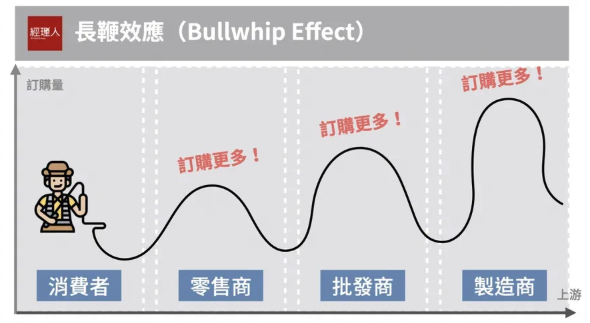
Theoretically, the bullwhip effect describes the phenomenon of demand signals amplifying along the supply chain. However, in practice, it manifests in a more brutal way:
- The frontline sees "orders skyrocketing or disappearing"
- Middle management sees "extremely unstable demand"
- Senior management sees "the market suddenly becoming unpredictable"
Consequently, companies initiate a series of "seemingly correct" governance actions:
- Demanding higher safety stock
- Increasing approval layers to control procurement
- Extending forecast cycles, attempting to flatten volatility
- Using KPIs to pressure sales and suppliers to "report more accurately"
The problem is that, all these governance actions are built upon already distorted information.
The result is not stability, but a further amplification of distortion.
Why the Bullwhip Effect Inevitably Evolves into a Governance Problem
The reason the bullwhip effect evolves into governance failure is not due to a lack of intelligence, but rather three structural problems:
1. Information is not flowing; it is being "rewritten"
In most manufacturing environments, the path of demand information transmission is as follows:
Customer Email → Sales manual interpretation → Excel → ERP → Procurement and Production
Each node is not merely relaying information, but reinterpreting it. Delivery anxiety, fear of material shortages, and performance pressure are all "reasonably" added during this process.
What ultimately enters the system is no longer market demand, but the crystallization of organizational fears.
2. Governance Systems Can Only Manage Numbers, But Cannot See Distortion
The board and senior management see orders, forecasts, and inventory turnover in the ERP.
But the system never tells you:
- Which orders were placed early to reserve capacity
- Which demands were inflated due to fear of stockouts
- Which cancellations could actually have been anticipated weeks ago
Governance sees the outcome, but not the distorted process that forms the outcome.
This forces management to react to symptoms rather than address the root cause.
3. Individual Rationality, When Superimposed, Creates Systemic Irrationality
For a single department:
- Reporting slightly more demand is self-preservation
- Pulling materials early is being responsible
- Conservative forecasting is to avoid accountability
However, when everyone makes the same "rational" choices, the entire system gravitates towards extreme volatility.
The reason governance fails here is simple: No single role is accountable for the overall distortion.
Insight: What I See Is Not the Bullwhip Effect, But a Governance Fault Line
In many companies, the real problems often occur "before the formal system."
It's not that the ERP is not powerful enough; it's that the information it receives is already contaminated.
Common phenomena include:
- Critical orders are hidden in email attachments and conversations
- Sales and procurement each have their "privately understood versions"
- System data is always slower than the real-world status
- Management can only conduct post-mortem reviews, unable to intervene proactively
These are not operational issues, but a lack of governance vision.
When companies cannot promptly see how demand is being distorted, any governance system can only stray further and further on a wrong map.
Truly Effective Governance is Not About Suppressing Forecasts, But Suppressing Distortion
Many companies try to "calculate more accurately" using AI, advanced algorithms, and more reports.
But if the input itself is distorted, models will only amplify errors more precisely.
Truly effective governance should return to three core questions:
- At which node does demand begin to be rewritten?
- Which decisions are based on fear rather than actual consumption?
- Can management see these deviations in real-time, instead of through post-hoc KPIs?
This is why the first step in managing the bullwhip effect is never a forecasting model, but rather the reconstruction of information structure.
The Bullwhip Effect is a Governance's Revealing Mirror
The reason the bullwhip effect repeatedly occurs is not because managers are not working hard enough, but because it reveals:
Most companies' governance systems are not built upon real demand.
When information is distorted layer by layer, governance devolves from a "decision-making system" into a "post-hoc rationalization tool."
The bullwhip effect is not a side effect of the supply chain, but a revealing mirror. What it reflects is not just inventory and delivery issues, but whether the enterprise truly possesses the ability to grasp reality.
If you are experiencing severe demand fluctuations, forecasts that constantly lag behind reality, and a significant disconnect between decision-makers and the frontline, then the problem likely lies not with the market, but with governance itself.
This is also the true risk that most companies have not yet recognized.
Get the next one before anyone else
New essays on supply chain governance, ERP and AI adoption. No spam, unsubscribe anytime.
Working through something like this?
I help manufacturers and founders untangle the process before they buy the tool.
Book a conversationWritten by
Wei Ting Chen
I work with manufacturers and founders on the part nobody wants to own: how work actually flows between people, systems and suppliers. Most of what gets blamed on the tool turns out to be a question of who decides what.
Keep reading
- CEO Analysis: The Fall of Social Commerce Giant 'Flip'Why did Flip, a billion-dollar social commerce platform, fall? This article provides an in-depth analysis of its mistakes, revealing fatal lessons about winner-takes-all dynamics in platform economics and misunderstanding the essence of community. Deep dive into subsidy frenzy, creator economics, and market myths, offering valuable warnings for all entrepreneurs and executives.
- Achieve Tenfold Growth with Tenfold DifferenceThis article delves into how "tenfold difference" leads to "tenfold growth," revealing innovative thinking and practical methods for achieving breakthrough goals through cases from Buffett to Musk. Learn the three key characteristics of tenfold innovation: feasibility, structural integrity, and relative stability, and master systematic thinking to create possibilities for tenfold growth in specific areas.
- CEO Analysis: Manufacturing's Hidden Productivity Black Hole - Supplier ManagementManufacturing companies are trapped in a hidden productivity black hole due to poor supplier management, with employees spending hours daily on manual ETL data processing. This CEO analysis dives deep into supply chain disconnects and proposes strategies like the Kraljic Matrix to help companies escape transactional drudgery and move toward efficient management.