CEO Analysis: The Fall of Social Commerce Giant 'Flip'
When Markets Soar, Why Is Your Platform Still Falling?
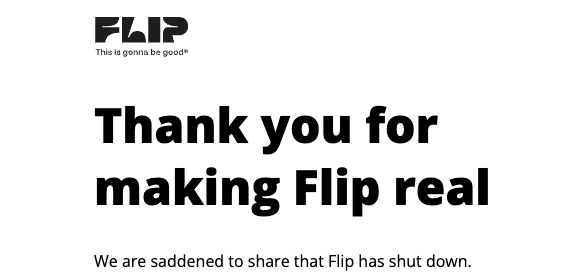
In August 2025, (Flip), a social commerce platform valued at $1.05 billion, quietly shut down (you can still see their apology statement—as a fellow entrepreneur, I can truly feel this regret...). Right now, the global social commerce market is racing toward a $2.6 trillion scale—
Markets are hitting historic highs, while star companies teeter on the edge of bankruptcy.
In most executive strategy rooms, we over-believe that "market size equals opportunity," while underestimating the iron law of "winner-takes-all" in platform economics.
Flip left behind 16.5 million users, 4.6 million creators, $375 million in brand sales, and one core question: When everyone sees the opportunity, why do the first movers crash the fastest?
Flip: We May Have All Misunderstood the Essence of Social Commerce
The essence of social commerce is "community," not "commerce." When platforms prioritize transactions over relationships, even the largest market can't save broken unit economics. The following three common false assumptions may be happening daily in your strategy meetings:
1\. "As long as we subsidize growth, network effects will naturally come"
This was Flip's fatal $300 million illusion. Subsidies can buy users, but not loyalty; they can buy transactions, but not community.
2\. "Creators want the highest monetization rate"
Creators want predictable income, maximized audience, and exposure. But Flip averaged just $2.60 per creator—yes, two dollars and sixty cents!!! This is essentially an insult to creators, making them not want to stay.
3\. "The market grows 26% annually, we just need to capture 1%"
In winner-takes-all platform battles, 1% market share means 98% of creators will leave you, because their opportunity cost lies in TikTok, Instagram, YouTube.
Flip's Subsidy Frenzy and Collapse

Flip's founder Nooruldeen Agha wasn't a first-time entrepreneur. He identified the short-video shopping trend and designed a "seemingly perfect" hybrid monetization model:
- Creators could profit through view counts ($15–25 subsidy per thousand views), affiliate commissions (5–15%), user interaction bonuses, etc.
- Users could earn rewards just by watching, swiping, inviting friends, redeemable for product discounts.
Surface data looked impressive: In April 2024, valued at $1.05 billion, 16.5 million users, 4.6 million creators, 12,000 partner brands on Flip, driving $375 million in sales.
But internal economics had already collapsed: The platform paid only $13.4 million total to 4.6 million creators, averaging $2.60 per person. Most creators earned near zero, yet had to keep producing content. This was a Ponzi-style growth sustained by creators' unpaid labor.
More fatal was the organizational tension: Growth team and creator success team goals were completely misaligned. The growth team used subsidies to drive user numbers, with KPIs like Daily Active Users (DAU) and Gross Merchandise Value (GMV), while the creator team couldn't provide enough revenue to retain quality content producers. When creators discovered "the same content reaches 10x the audience on TikTok with higher monetization," departure was just a matter of time.
Market Growth ≠ Your Growth
- Global social commerce market: Reached $2 trillion in 2025, projected $2.6 trillion in 2026, 26.2% CAGR. But TikTok Shop's Q3 2025 single-quarter GMV reached $19 billion, approaching eBay's annual revenue.
- Consumer behavior contradiction: 63% of Americans think social platforms are good for discovering products, but 76% ultimately return to retailer websites to complete purchases (usually based on trust and security concerns). This means independent platforms like Flip must overcome a "double conversion" problem: convince users to explore new products on Flip's platform, then convince them to buy there, fighting against deeply ingrained behavioral inertia.
- Creator revenue reality: Flip total payments $13.4 million ÷ 4.6 million creators = $2.60 per person. Median revenue likely near zero. When most creators can't make a living, the content ecosystem inevitably withers.
Network Effect Layers and Traps
Three-layer structure of platform competition (based on comparison of Flip vs. TikTok, Amazon):
Layer 1: Native entertainment platforms extending into commerce (e.g., TikTok Shop)
Entertainment is the core, shopping is a natural extension. Users are already on the platform, no subsidies needed. Network effects self-reinforce.
According to Parker & Van Alstyne's 2005 "multi-sided platform theory," platforms can only form sustainable ecosystems when growth on one side (creators) strengthens the experience on the other (consumers). For example: TikTok's creators and viewers have already formed strong network effects; commerce is just one monetization channel.
Layer 2: Existing retail platforms adding social features (e.g., Amazon Inspire, Facebook Shops)
User mindset is "transaction-first," social features feel like add-ons, conversion rates are low. Amazon Inspire's click-to-purchase rate is only 0.8%, far below e-commerce benchmarks.
Organizational reality: These projects are usually treated as "innovation experiments" within enterprises, marginalized in resource allocation, and teams lack social product DNA.
Layer 3: Independent social commerce startups (e.g., Flip)
Structural dilemma: Must simultaneously fight TikTok's network effects, Amazon's trust endorsement, Instagram's social graph. The only weapon is subsidies, but you can't have endless subsidies to sustain for a century.
Execution Debt: Short-term subsidy-driven "fake growth" makes organizations misjudge product-market fit and masks real retention problems.
Sun Tzu's Art of War says: "Know the enemy and know yourself, and you can fight a hundred battles without disaster; know yourself but not the enemy, win one lose one; know neither enemy nor yourself, every battle is a disaster."
Translated into management language: If you only know you have funding and a team, but don't understand competitors' established "network effect moats" and users' "cross-platform migration costs," every battle will exhaust resources with nothing to show.
If You're an Executive Working with Creators, Consider These 3 Things
1\. Break down your "creator unit economics": Work with finance and operations teams to calculate median creators' actual monthly income on your platform (not average). If median income is below their opportunity cost (e.g., potential income on other platforms), immediately adjust monetization strategy, even if it temporarily reduces GMV.
2\. Conduct "real retention interviews": Find 10 creators and users inactive in the last 30 days. Don't ask "why did you leave," but "which platform are you spending time on/earning revenue from instead of us?" You'll be surprised by their honest answers, and the responses will directly point to your structural weaknesses.
3\. Redefine what "victory" metrics look like: In your next strategy meeting, move "GMV growth" from the top spot and replace it with "creator revenue sustainability index" (e.g., top 10% creator retention rate, median creator monthly income YoY growth).
3 systems/rhythms/responsibilities you can adjust this quarter:
1\. Restructure incentive systems to align "creator success" and "platform growth" team goals
Eliminate growth team bonuses based solely on user count and GMV. Switch to mixed metrics: 50% based on user retention (especially users brought by creators), 30% based on creator satisfaction survey scores, 20% based on GMV. This forces the organization to shift from "buying growth" to "nurturing ecosystem."
2\. Establish quarterly "network effect health" audits
Have the Chief Strategy Officer or CEO's direct team report quarterly:
(1) What percentage of user acquisition costs go to subsidies (vs. organic growth)?
(2) Is creators' content "cross-platform exclusivity rate" rising or falling?
(3) User "single-platform usage duration" vs. "multi-platform usage" trend comparison.
These metrics predict long-term survival better than market share.
3\. Give product teams the power to "reject short-term monetization"
Clearly define: Any new feature that might harm content consumption experience (e.g., forced shopping popups, excessive reward interruptions), even if estimated to boost short-term GMV, the Chief Product Officer has veto power. This needs board backing to prevent sacrificing long-term ecosystem under investor pressure.
Peter Drucker once said: "Efficiency is doing things right; effectiveness is doing the right things."
In platform competition, "doing things right" is optimizing subsidy conversion rates; "doing the right things" is choosing not to subsidize, instead investing in "community trust" that can't be quickly quantified. The latter often looks inefficient on financial statements, but it's the only path to survival.
In a Winner-Takes-All World, Where Is Your Position?
Flip's collapse isn't social commerce's failure, but the structural dilemma of "Layer 3 platforms" at this stage. When you're in a rapidly growing market but feel growth getting harder and subsidies getting heavier, first ask yourself one question:
"Are we ecosystem builders, or subsidy porters?"
If it's the latter, then all growth is debt, all valuations are illusions. True platform advantage isn't about how many users you have, but how many users are willing to stay without rewards; not about how many transactions you facilitate, but how many creators see you as their primary monetization base.
It's simple math. Next quarter, when your team presents optimistic financials based on market growth projections, print Flip's $2.60 per-creator revenue on the cover. That's a $1.05 billion lesson: You can buy transactions, but not community; you can buy growth, but not network effects. In this era, the latter is the only moat.
Get the next one before anyone else
New essays on supply chain governance, ERP and AI adoption. No spam, unsubscribe anytime.
Working through something like this?
I help manufacturers and founders untangle the process before they buy the tool.
Book a conversationWritten by
Wei Ting Chen
I work with manufacturers and founders on the part nobody wants to own: how work actually flows between people, systems and suppliers. Most of what gets blamed on the tool turns out to be a question of who decides what.
Keep reading
- Paper Discussion: Governance Failure Caused by the Bullwhip EffectThe bullwhip effect is not just a supply chain forecast error; it deeply leads to corporate governance failure, causing management to make decisions based on distorted perceptions of reality. This article deeply analyzes three structural problems, including information rewriting and system blind spots, revealing governance discontinuities and emphasizing that rebuilding information structure is the fundamental solution.
- Achieve Tenfold Growth with Tenfold DifferenceThis article delves into how "tenfold difference" leads to "tenfold growth," revealing innovative thinking and practical methods for achieving breakthrough goals through cases from Buffett to Musk. Learn the three key characteristics of tenfold innovation: feasibility, structural integrity, and relative stability, and master systematic thinking to create possibilities for tenfold growth in specific areas.
- CEO Analysis: Manufacturing's Hidden Productivity Black Hole - Supplier ManagementManufacturing companies are trapped in a hidden productivity black hole due to poor supplier management, with employees spending hours daily on manual ETL data processing. This CEO analysis dives deep into supply chain disconnects and proposes strategies like the Kraljic Matrix to help companies escape transactional drudgery and move toward efficient management.