CEO Analysis: We Are All Trapped in Different 'Production Modes'
▍TSMC's Lesson: When Forecasts Become a Collective Gamble
Everyone knows TSMC is formidable. But even such a giant can get tripped up by its own rules of the game.
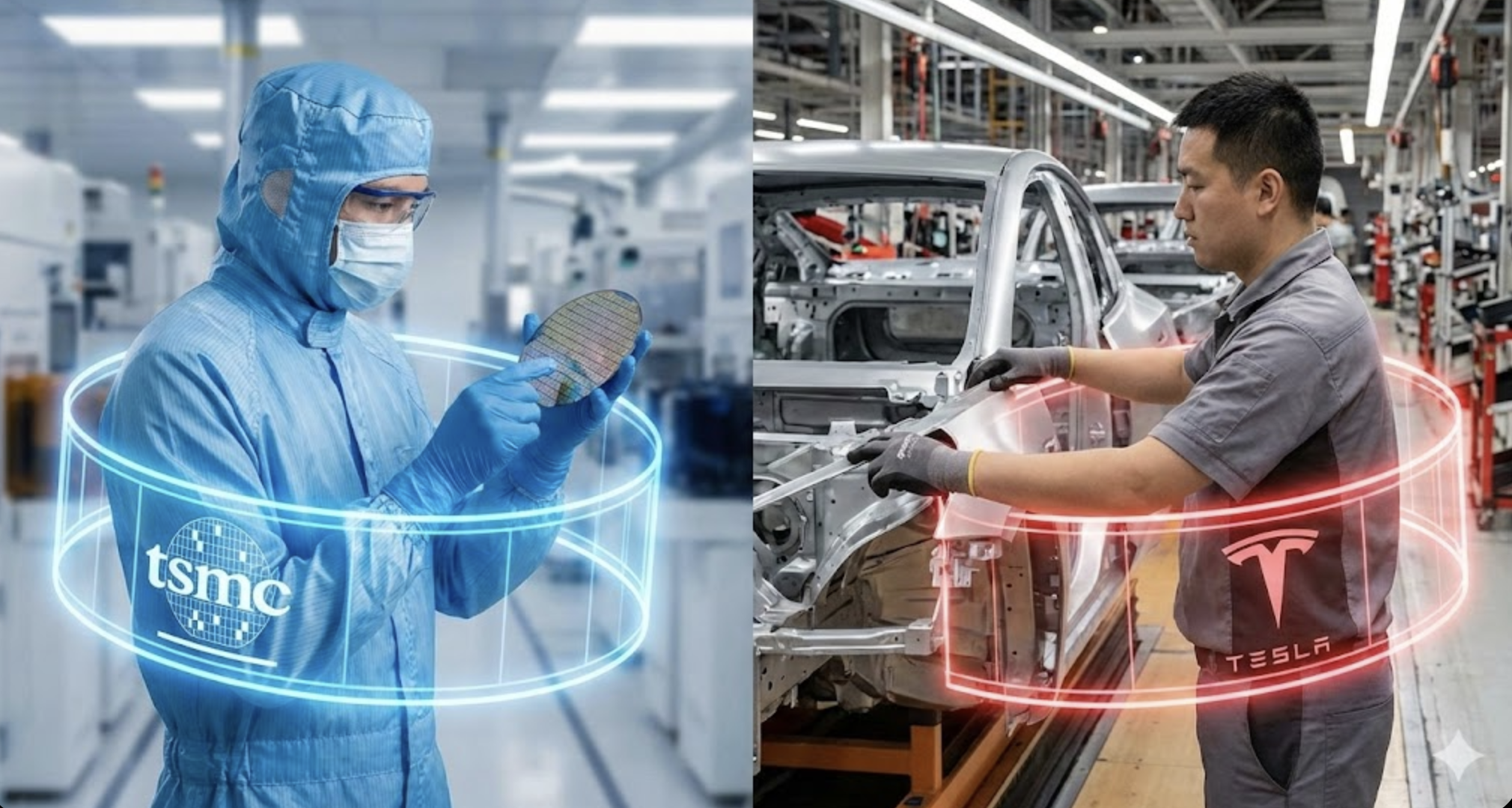
Around 2015, the entire industry believed that the Internet of Things (IoT) would bring explosive growth. Based on this "reasonable forecast," TSMC made one of its largest capital investments in history, revising its capital expenditure upwards to $13.4 billion within a year to build new factories, purchase equipment, and expand capacity.
The logic behind this was a typical MTS (Make-to-Stock) mode: predicting future demand and preparing production in advance.
The problem is, when the entire organization believes the same forecast, no one dares to genuinely question it.
- Business departments took clients' "optimistic but vague" demand commitments and reported the numbers.
- The KPI for factory operations is capacity utilization; they naturally supported expansion—the fuller the production lines, the better their performance.
- Senior decision-makers, faced with unanimously optimistic departmental reports and Wall Street's praise for "aggressive investment," found it difficult to press the veto button.
Thus, a gamble based on collective optimism began.
But the market didn't follow the script. IoT's explosion was slower than expected, and smartphone growth was also decelerating. By 2016, warning signs emerged: capacity utilization steadily declined from near full capacity.
At this point, the organization's true nature was revealed: responsibilities became blurred, and decisions became sluggish.
- Sales said, "It was the client who changed their mind last minute."
- The factory said, "It was the inaccurate sales forecast."
- Finance was calculating losses but didn't know whom to hold accountable.
No one wanted to be the first to admit, "We bet wrong," because that would mean refuting a decision they had fully supported just months earlier. This "defensive mindset" led to delayed corrective actions, and every day's delay translated into staggering depreciation costs and profit erosion.
I believe: The true risk of the MTS model is not that "forecasts can be inaccurate" (everyone knows that), but rather that "once a forecast is inaccurate, the organization is not prepared to quickly and frictionlessly bear the consequences." Responsibilities are designed to be too dispersed, such that no one has the incentive or power to hit the emergency brakes.
Even today, the high inventory turnover days across the entire semiconductor industry indicate that this structural issue of "forecasting and responsibility" still persists.
▍Tesla Suppliers' Dilemma: When Collaboration Becomes One-Sided Pressure
At the other extreme are clients like Tesla who adopt an ETO/MTO (Engineer-to-Order/Make-to-Order) mode. They don't mass-produce in advance but start only after receiving an order or finalizing a design.
Sounds reasonable, right? But for its suppliers, it often turns into a nightmare.
Tesla is known for "extreme optimization" and rapid iteration. This means that a supplier who has just invested tens of millions in molds and production lines for a design might soon receive an Engineering Change Order (ECO), requiring design modifications for cost reduction and efficiency improvements.
Each change represents real sunk costs for the supplier: scrapped old molds, re-adjusted production lines, retraining of personnel, and obsolete inventory parts. Tesla rarely compensates for these costs in contracts. Suppliers can only silently amortize them into future years' gross profits, invisibly eroding their margins.
A more dramatic example is the "Giga Casting" integrated die-casting technology. Tesla strongly promoted it, and suppliers subsequently invested heavily in developing related processes. However, when the technology encountered bottlenecks (extremely high initial defect rates), Tesla decided in 2024 to partially abandon the overall plan and switch to a hybrid solution.
For suppliers, this meant that a significant portion of the R&D and production line preparation invested in Giga Casting became sunk costs. The initiative for decision-making was entirely out of their hands.
The structural problem here is an absolute "power imbalance." For key suppliers like Hota and Futian, Tesla's orders might account for 30-50% of their revenue. This leaves them with virtually no bargaining power at the negotiation table, forcing them to passively absorb huge costs from all client demand changes, cost pressures, and strategic shifts (such as the sudden request for "de-Sinicization of the supply chain").
My reflection is: The trap of the ETO/MTO model lies in its assumption that "demand is clear and stable." But when the client itself is undergoing rapid iteration and uncertainty, all variable costs and risks are unilaterally transferred to the weakest link in the supply chain through unequal power relationships. This is not collaboration; it is a hidden form of cost extraction.
▍Our Shared Dilemma: Misalignment of Power and Cost
Looking at these two cases together reveals a profound paradox:
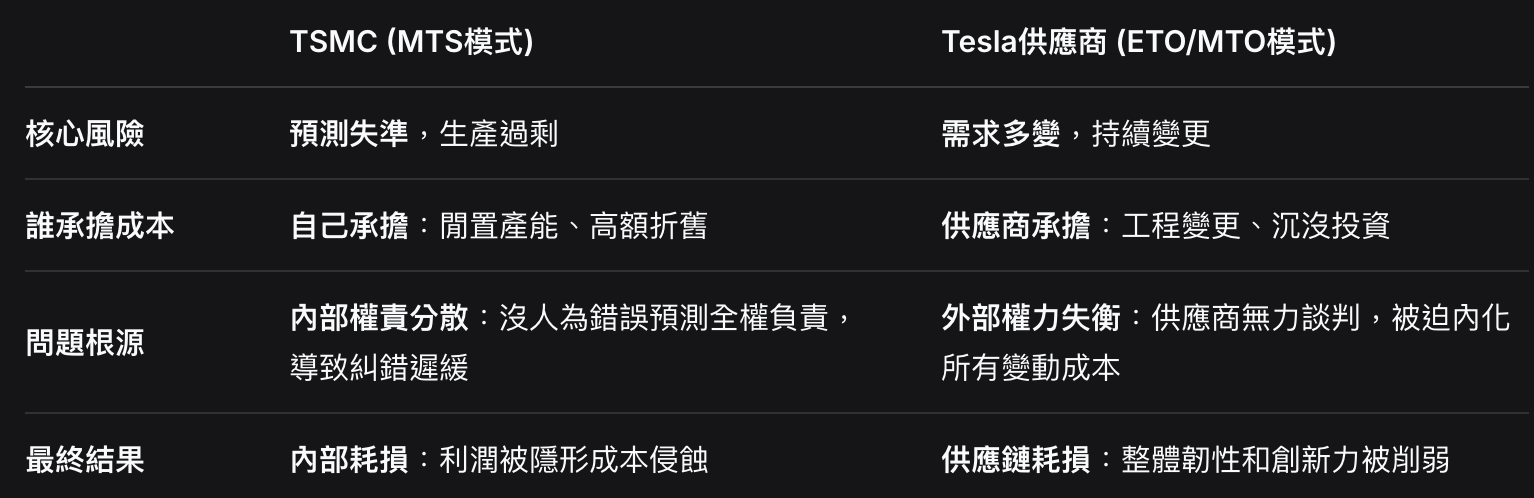
They are like two sides of the same coin:
- At TSMC, costs spiral out of control due to an internal "responsibility vacuum."
- In Tesla's supply chain, costs are shifted due to an external "power vacuum."
Both point to the same core problem:
When facing uncertainty, our organizational models and business relationships are not designed with a fair and efficient mechanism for cost bearing and decision correction.
▍A Reminder to Myself
As an entrepreneur and operator, these two cases offer me the greatest warnings:
1\. Don't blindly believe in any "best model": There's nothing inherently wrong with MTS or ETO/MTO; the mistake is failing to design buffers and checks and balances for their inherent flaws. We need to regularly examine: When the underlying assumptions of this model are broken, who pays the price? How significant is that price?
2\. Focus on "hidden power structures": True costs are often not recorded on financial statements but hidden behind departmental silos and in unequal contractual relationships. Loss of profit often stems from blurred responsibilities or loss of bargaining power.
3\. Design for "resilience," not just "efficiency": Maximally optimized single-point efficiency is often the most fragile when encountering black swans. Whether it's internal organization or external supply chains, space and rules must be provided to handle errors and changes.
Competition in manufacturing is no longer just about technology and scale; it's increasingly about organizational design wisdom and the depth of business ecosystem collaboration. Can we break free from either/or model traps and find a superior balance between power and responsibility, efficiency and resilience?
Get the next one before anyone else
New essays on supply chain governance, ERP and AI adoption. No spam, unsubscribe anytime.
Working through something like this?
I help manufacturers and founders untangle the process before they buy the tool.
Book a conversationWritten by
Wei Ting Chen
I work with manufacturers and founders on the part nobody wants to own: how work actually flows between people, systems and suppliers. Most of what gets blamed on the tool turns out to be a question of who decides what.
Keep reading
- Paper Discussion: Governance Failure Caused by the Bullwhip EffectThe bullwhip effect is not just a supply chain forecast error; it deeply leads to corporate governance failure, causing management to make decisions based on distorted perceptions of reality. This article deeply analyzes three structural problems, including information rewriting and system blind spots, revealing governance discontinuities and emphasizing that rebuilding information structure is the fundamental solution.
- CEO Analysis: The Fall of Social Commerce Giant 'Flip'Why did Flip, a billion-dollar social commerce platform, fall? This article provides an in-depth analysis of its mistakes, revealing fatal lessons about winner-takes-all dynamics in platform economics and misunderstanding the essence of community. Deep dive into subsidy frenzy, creator economics, and market myths, offering valuable warnings for all entrepreneurs and executives.
- Achieve Tenfold Growth with Tenfold DifferenceThis article delves into how "tenfold difference" leads to "tenfold growth," revealing innovative thinking and practical methods for achieving breakthrough goals through cases from Buffett to Musk. Learn the three key characteristics of tenfold innovation: feasibility, structural integrity, and relative stability, and master systematic thinking to create possibilities for tenfold growth in specific areas.